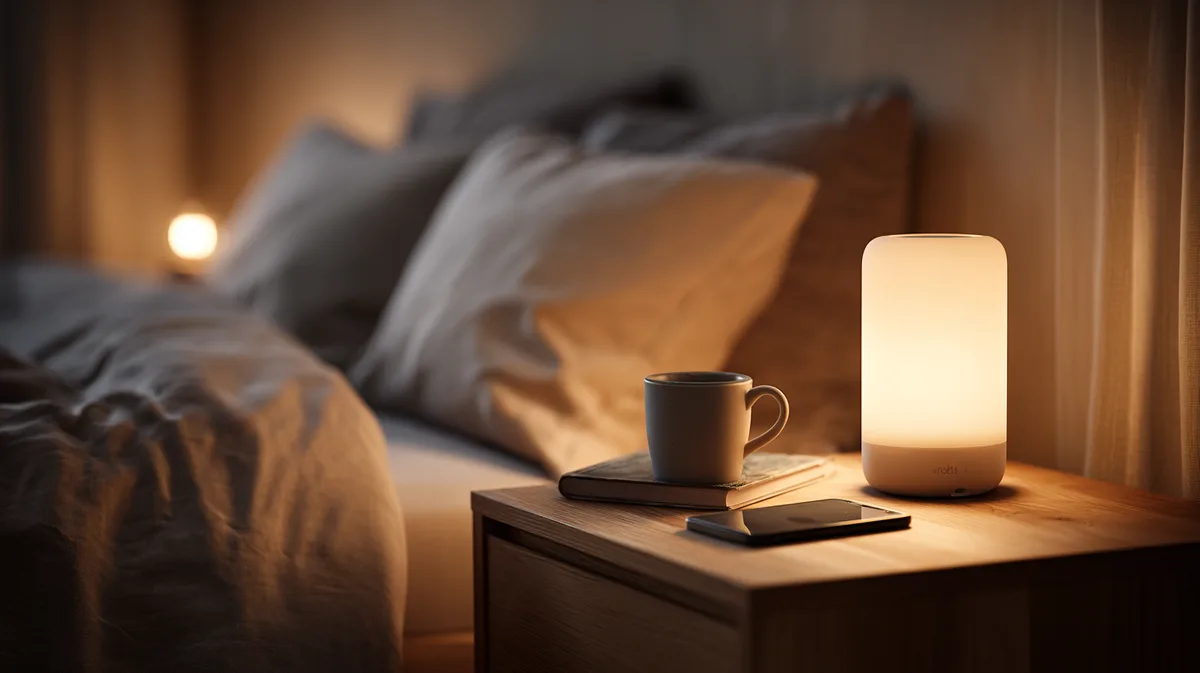
You're tired. You know you're tired. But ten minutes after lights-out, your eyes are still open, so you do what 48% of smartphone users do without thinking, and you reach for your phone out of pure muscle memory. Twenty minutes of reels later, you're wider awake than when you started.
This isn't bad luck. It's biology working exactly as designed, although it's working against you.
The blue light trap nobody outgrows
The screen in your hand emits short-wavelength blue light that your brain cannot distinguish from daylight. When that light hits your retina after dark, it suppresses melatonin (the hormone that signals your body to wind down). Your brain registers that the sun is up and fires off the corresponding wake-up chemistry. You're not failing to fall asleep. Your phone is actively telling your body to stay awake.
That's just the chemical layer. Underneath it sits a stimulation problem. Every swipe, every auto-playing clip, every notification badge triggers small dopamine hits that keep your prefrontal cortex engaged. Shutting that down and dropping into the low-arousal state sleep requires doesn't happen on command. Gloria Mark's research at UC Irvine found that after even a work interruption, it takes an average of 23 minutes and 15 seconds to fully refocus. A bedtime scroll session is the same mechanism, except you're trying to refocus on nothing, which is even harder.
The compounding effect is brutal. Poor sleep erodes focus the next day, which drives more phone use as a coping mechanism, which erodes the next night's sleep. The hours before midnight aren't separate from the hours at your desk tomorrow. They're the same account.
The Simple Fix
Here's what actually changes it: put an NFC tag on your bedside table and link it to Tapd. Tap before you get into bed, not after you've already started scrolling — as the first action of the routine, not a rescue attempt partway through it. The phone locks down, the distractions disappear, and your brain never gets the blue-light signal that would have kept it wired. It's a two-second ritual, and it works because it's too small to talk yourself out of.
There's research behind why the physical gesture matters. A Harvard Business School study found that pre-performance rituals measurably reduced anxiety and improved outcomes, even when participants invented the ritual themselves. The tap isn't magic. It's a consistent boundary marker that tells your brain this is when the day ends.
Where it gets interesting: accountability you can see
Sleep is one entry point, but the mechanic that surprises people is the group layer. Our team runs a shared Tapd group during work hours. Everyone taps in, and the activity monitor shows who's currently locked in and who isn't. No surveillance software, no screenshots, no micromanagement — just visibility.
A 2008 study by Gerber, Green, and Larimer (one of the most cited field experiments in political science) showed that simply letting Michigan voters see whether their neighbors had voted raised turnout by 8.1 percentage points, dwarfing the effect of phone canvassing and mailers. The mechanism wasn't shame. It was the awareness that your behavior was observable. The same dynamic plays out in a Tapd group: knowing your focus time is visible makes you more likely to actually focus.
The weekly leaderboard sharpens it further: skipping a session doesn't just cost you privately, it leaves a visible gap in a record your team can see. That's a different kind of pressure than a screen-time report ever applied.
The thing we didn't expect
Sleep is usually where people start with Tapd. What catches most of them off guard is that the same two-second tap restructures how they think about attention during the day too. Attention stops being a willpower problem and becomes a visible commitment to a group that's counting on you. Better sleep makes deeper focus possible. Visible focus makes the sleep ritual feel worth protecting.
Fifty-three percent of Americans say they want to cut their phone use. Wanting isn't the bottleneck. The bottleneck is that desire lives inside the same device it's trying to fight. The way out isn't another app notification reminding you to put your phone down. It's a physical action, a visible community, and a reason to care about both.
Tapd is a focus app built for groups: NFC tap-in, app blocking, and a leaderboard that makes focus competitive. Download on the App Store.