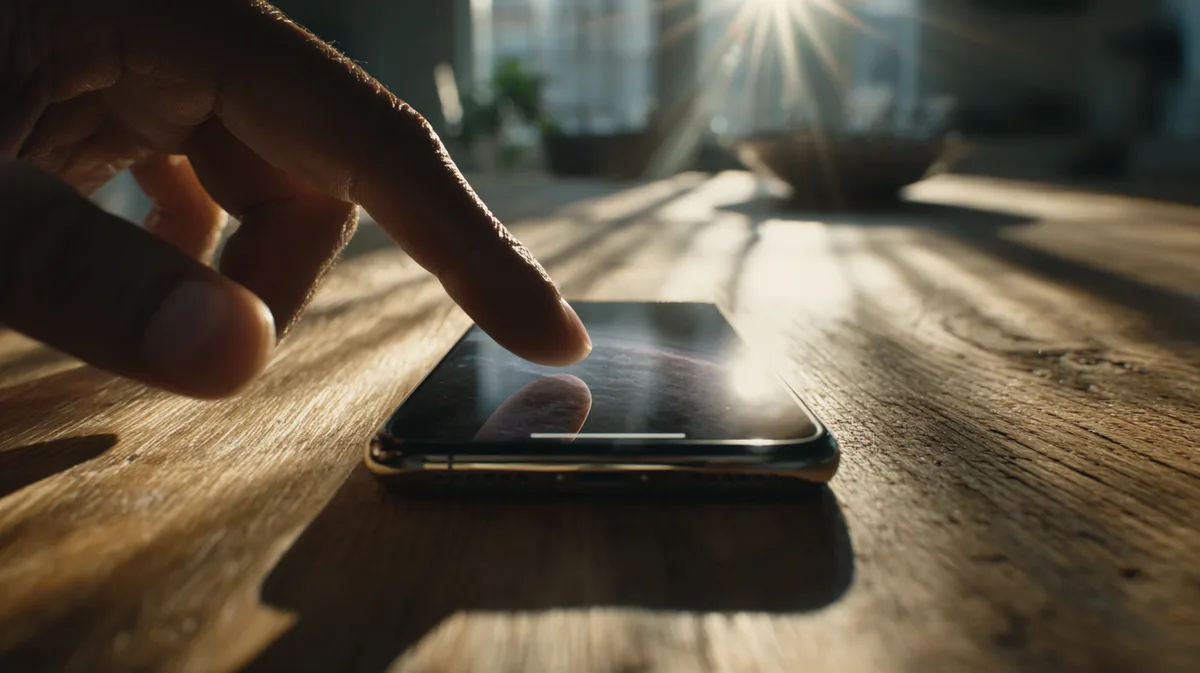
You reach for your phone without deciding to. On an average day, you'll do this about 58 times, and if you're honest, you couldn't explain why for most of them. If that feels like weakness, it isn't. The behavior works exactly the way it was designed to work. Which means if you want to change it, you need to understand what's actually happening in your head when that notification fires.
Most advice about phone use starts and ends with willpower. Delete the apps. Put the phone in another room. Try harder. The advice isn't wrong, but it misses the scale of what you're up against. Every app on your phone was built by teams of engineers and psychologists studying the same behavioral research casinos use. They weren't built to help you. They were built to win a battle for your attention. Understanding how that battle works is the first step to taking your time back.
The dopamine loop, explained simply
You probably already know the word “dopamine” from half a dozen productivity articles. Here's what most of them get slightly wrong: dopamine isn't the chemical of pleasure. It's the chemical of anticipation.
When your phone buzzes, your brain gets a small hit of dopamine before you even check the screen. You don't know yet if the notification is interesting or boring. That uncertainty is the point. B.F. Skinner's mid-century research on variable reinforcement schedules showed that unpredictable rewards drive stronger behavior than predictable ones. Pigeons pressing a lever for food that arrived sometimes, but not always, pressed harder and longer than pigeons who got food every time. Slot machines work on the same principle. So do the notifications on your phone.
Every time you pull down your notifications tray, you're running Skinner's experiment on yourself. Most pulls are boring. Occasionally, one is interesting. Your brain files the interesting one and discounts the boring ones. The next time you feel the urge to check, you check again. Roughly 48% of smartphone users pick up their phone out of pure habit, with no specific intention. Not because they're weak. Because the loop is working.
The 23-minute problem
Even if you resist the dopamine loop, there's a second cost hiding underneath. Gloria Mark's research at UC Irvine found that after an interruption, it takes an average of 23 minutes and 15 seconds to fully regain focus on the original task. Twenty-three minutes. For a single interruption.
Sit with that number for a second. If you check your phone three times during a study session, you've spent over an hour in cognitive recovery. You didn't feel those minutes pass. You felt like you studied. The data says otherwise.
This is why the American Psychological Association estimates task-switching can eat up to 40% of productive time. The cost isn't in the checking itself. It's in the invisible trail of half-focused minutes afterward. You can measure sessions after the fact and see the gap between what you think you did and what you actually did.
Why “just try harder” fails
Your phone is not a neutral object. It's an attention engine tuned by thousands of people whose full-time job is to make it harder to put down, and every one of them is still on the clock while you're trying to work. Betting your willpower alone beats that, every day, forever, is a bet you eventually lose, and the reason has nothing to do with how weak you are.
This is also why most phone-use apps fail. They ask you to commit to something abstract, “use my phone less,” and hope you'll remember that commitment every time a notification fires. You won't. Nobody does. The intention is there in the morning and gone by 2 PM.
What actually changes the cycle
The research points to a different approach: don't fight your willpower, redesign your environment.
Add friction.Behavioral psychology has a name for this: commitment devices. You pre-commit to a decision when your willpower is strong, so that later, when your willpower is weak, the decision is already made. A phone sitting in another room is harder to pick up than one in your hand. A locked app is harder to open than one that's a thumb-scroll away.
Make the commitment physical. A Harvard Business School study by Brooks and colleagues found that pre-performance rituals measurably reduced anxiety and improved outcomes, even when participants invented the rituals themselves. The content of the ritual mattered less than the fact that there was one. A repeatable physical action creates a psychological boundary your brain can use to shift states.
Make the effort visible. Private discipline is fragile because nobody notices when you break it. But when your behavior becomes visible to a small group of people who care, the cost of bailing goes up. A focus session you log alone is easy to skip. A focus session your roommate, study partner, or sibling can see? Much harder.
The Tapd mechanic
This is what Tapd is built around. You place an NFC tag where deep focus happens. Tapping it with your phone locks distracting apps for however long you set, and your group on the Together Meter can see you're in a session. Three behavioral levers, all pulling in the same direction: the physical commitment device replaces the willpower decision, the app block removes the variable-reward loop, and the social layer makes the session harder to quietly bail on.
None of this requires you to be more disciplined than you are today. It just requires you to design the environment once, instead of winning the willpower fight a hundred times.
The honest takeaway
Phone addiction isn't a moral failing. It's the predictable outcome of putting ordinary human brains next to software engineered by thousands of people to capture their attention. Understanding the mechanism doesn't automatically free you from it, but it does change what you aim at. You stop fighting yourself and start changing the conditions your self has to operate in. That's where real habit change lives.
Tapd is a focus app built for groups: NFC tap-in, app blocking, and a leaderboard that makes focus competitive. Download on the App Store.